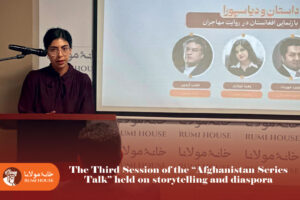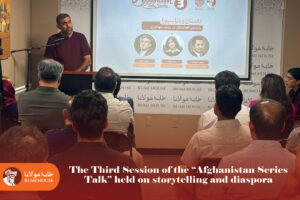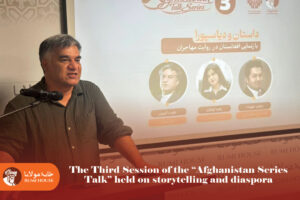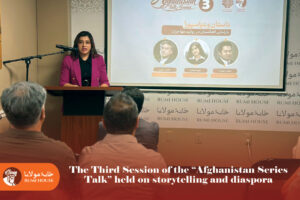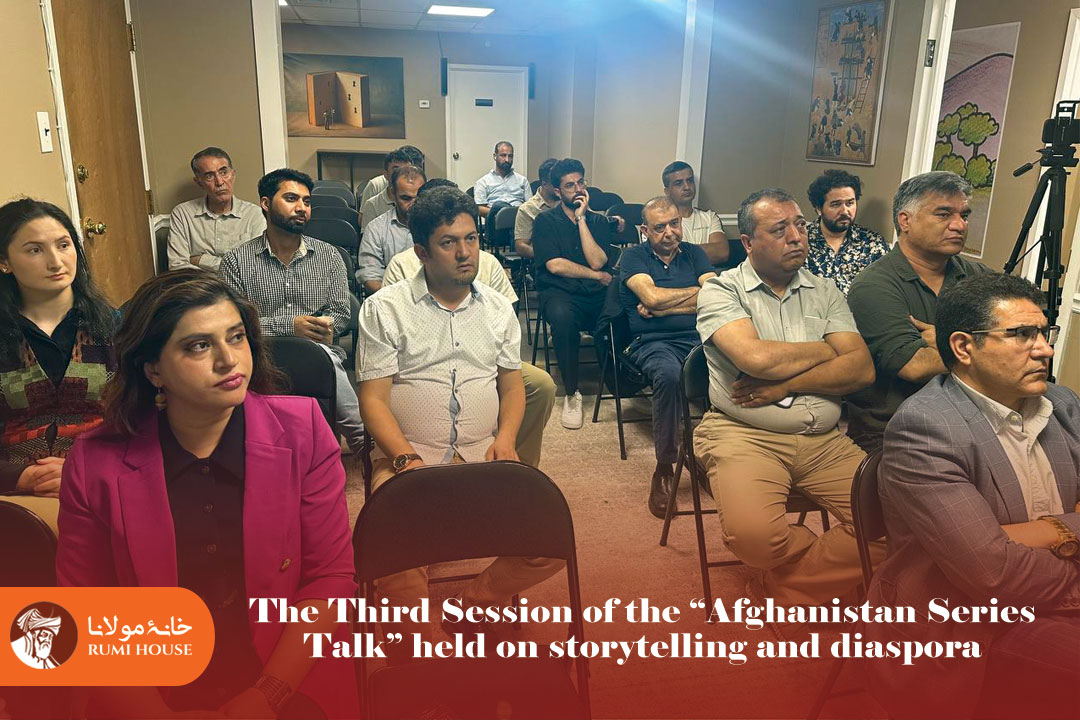
The third session of the “Afghanistan Talk Series” titled “Storytelling and Diaspora: Representing Afghanistan in Migrant Narratives,” was held at the Rumi House in Virginia, US, with the participation of several writers, researchers, cultural figures, and students. The session was organized with the aim of examining diaspora fiction, exploring how Afghanistan is represented in the works of migrant writers, and analyzing the role of storytelling in preserving the historical, cultural, and identity memory of the Afghanistan community in exile.
Amina Azarm Nizami, the program moderator, welcomed the attendees and introduced the third session of the “Afghanistan Talk Series” focused on storytelling and diaspora. She also explained its objectives and themes. She stated that the program provides an opportunity to discuss diaspora literature, the experiences of writers in exile, and the ways in which identity, culture, and collective memory are reflected in fictional works.
Mirwais Balkhi welcomed the participants and spoke about the programs and activities of Rumi House. Referring to the institution’s cultural mission of promoting scholarly, literary, and cultural dialogue, he emphasized the importance of addressing the subject of literature and diaspora and described the session as part of Rumi House’s ongoing efforts to create opportunities for dialogue and intellectual exchange on issues related to Afghanistan. Balkhi also highlighted the organization’s educational initiatives, noting that the Rumi School has already begun its activities and is currently offering mother-language classes for children and adolescents as part of its summer programs, with the aim of turning the school vacation period into an opportunity for learning, strengthening their native language and indigenous cultural heritage, and fostering a deeper connection with their cultural roots.
Naqib Arvin, a fiction writer, spoke about the concept of diaspora literature, its characteristics, and its formation process. Referring to several writers from Afghanistan who have narrated migration experiences and represented Afghanistan in their stories while living abroad, he examined examples of this trend. He noted that despite the valuable works published in recent years, Afghanistan’s diaspora fiction has not yet developed into a fully established or widely influential literary movement, and this field still requires further research, critical engagement, institutional support, and creative production.
Zohra Orakzai, a fiction writer, shared her lived experience of migration and its impact on her writing. She stated that she has always tried to reflect Afghanistan, its culture, memories, and the experiences of its people in her fiction, maintaining a connection to her ancestral homeland through narrative. She added that nostalgia for the homeland and concerns of identity has been among the most significant elements shaping her work, and she has consistently sought to present a humane and authentic image of Afghanistan to readers, especially younger generations and international audiences.
Mujib Mehrdad, a writer and literary critic, analyzed storytelling and diaspora from a literary and critical perspective. Reviewing examples of diaspora fiction, he discussed the formation of this branch of literature and introduced and examined the works of several prominent writers of Afghanistan in this field. He emphasized the role of migrant literature in reflecting experiences of exile, displacement, identity crisis, longing for home, and the reconstruction of collective memory within Afghanistan. He further stressed that fiction could serve not only as a literary narrative but also as a historical and social document of a nation’s lived experiences.
Despite differences in their approaches and experiences, the speakers emphasized the importance of diaspora literature in preserving cultural identity, documenting migration experiences, and introducing Afghanistan to the world. They highlighted the role of storytelling in fostering dialogue among migrant generations, maintaining connections with the homeland, and reflecting the social and cultural realities of Afghanistan. They also noted that the development of this field requires further research, critical study, and stronger support for Afghan writers abroad.
At the end of the program, participants engaged in discussions with the speakers and raised their views and questions regarding diaspora literature, the experience of writing in migration, the challenges of representing Afghanistan in fiction, and the future of this literary current. The session was met with considerable interest from literature enthusiasts and turned the third round of the “Afghanistan Talk Series” into an opportunity for exchanging ideas on one of the important topics in contemporary Afghanistan literature.