
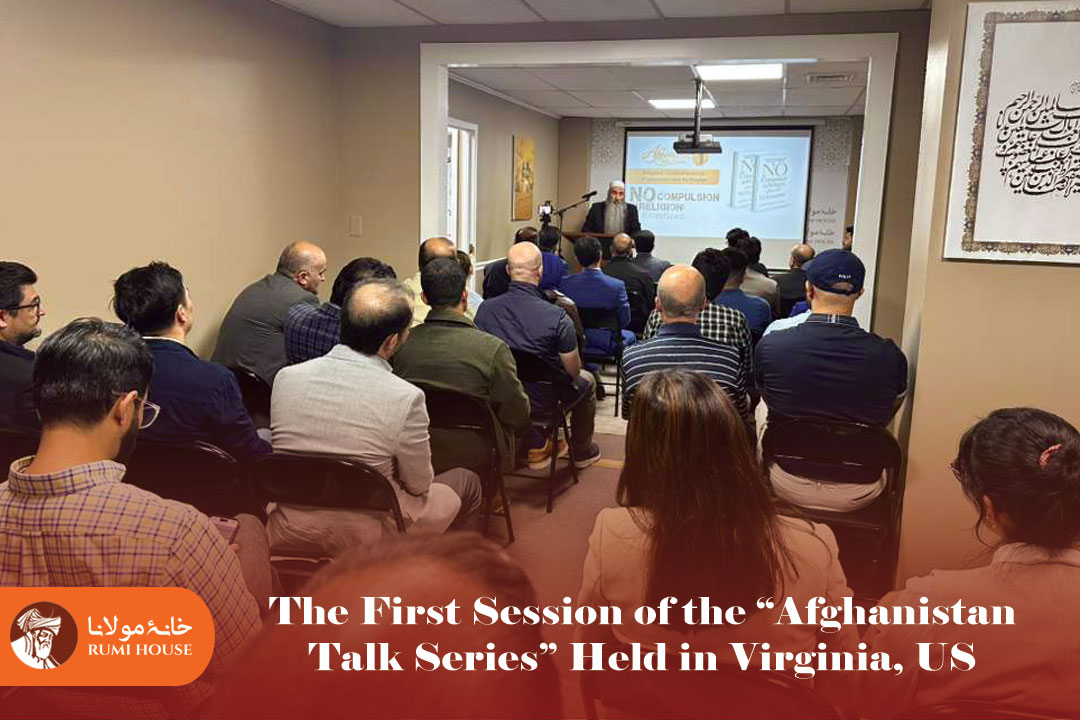
The inaugural session of the Afghanistan Talk Series, titled “Religious Totalitarianism in Afghanistan and the Region,” along with the launch of the book No Compulsion in Religion: No Exceptions, was held on Friday at Rumi House in Virginia. The event brought together author Mustafa Akyol, scholars, university professors, researchers, and members of the diaspora community from Afghanistan living in Virginia, Washington D.C., and Maryland.
The program opened with remarks by Waheed Gularani, who framed the evening’s discussion around a central question: How has religious coercion persisted in some Muslim societies despite the Qur’an’s explicit affirmation that “there is no compulsion in religion”? He described the issue as historical, political, and deeply human.
Mirwais Balkhi, President of Rumi House, welcomed participants and explained that the purpose of launching the Afghanistan Talk Series is to create a platform for deep, multidimensional conversations on major issues affecting Afghanistan and the region. He expressed appreciation for Akyol’s book, calling it significant and thought‑provoking, and noted that it reinterprets religion as a source of liberation and moral guidance rather than a tool of coercion.
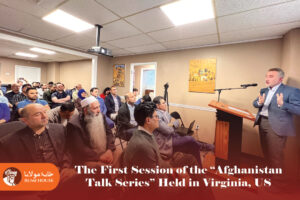
Omar Sharifi, Country Director of AIAS, offered an anthropological analysis of the evolving role of religion in Afghanistan’s society. He explained that in recent decades, Islam in Afghanistan has shifted from a lived, diverse cultural tradition to a rigid ideological framework. Drawing on experiences from the first Taliban regime, he described how religion was transformed into an instrument for enforcing compulsory identity. Historically, he noted, Islam in Afghanistan was expressed through literature, mysticism, and communal life rather than through imposed interpretations.
Dr. Mohammad Osman Tariq, a scholar of Islamic studies, critiqued common misinterpretations of Qur’anic verses and prophetic traditions. He emphasized that proper understanding of religious texts requires attention to Qur’anic context, historical circumstances of revelation, and their connection to authentic hadith. Addressing debates on apostasy and women’s rights, he argued that the principle of “no compulsion in religion” is foundational, and that contrary interpretations stem from inaccurate and ahistorical readings. He called for a revival of rigorous scholarly approaches to religious interpretation.
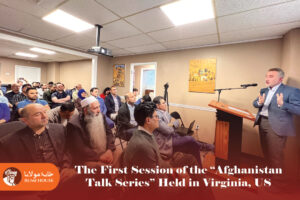
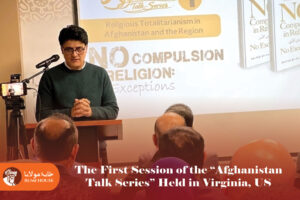
Author Mustafa Akyol presented the central arguments of No Compulsion in Religion: No Exceptions. Drawing on examples from Afghanistan, Iran, and other Muslim-majority countries, he demonstrated how state institutions have attempted to regulate religious behavior through coercion. He also referenced historical cases, including strict movements during the Ottoman era, to show that Islamic tradition has long included strong voices opposing religious compulsion. According to Akyol, imposing belief weakens religion itself and fosters hypocrisy and social dissatisfaction.
Akyol later responded to participants’ questions about his latest work.
The session concluded with strong engagement and a warm reception from attendees.