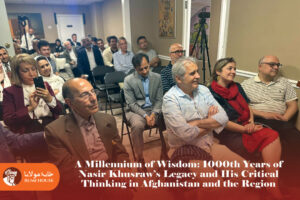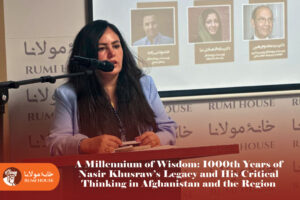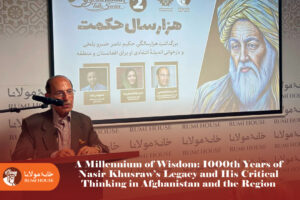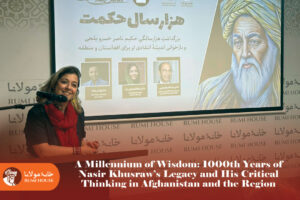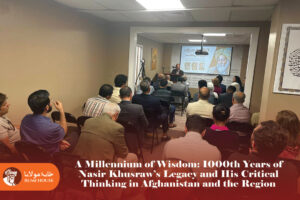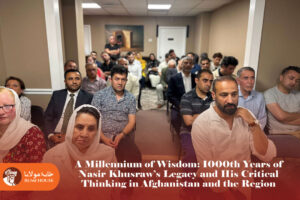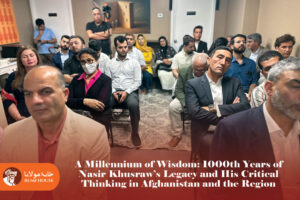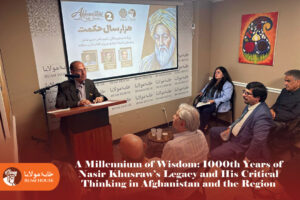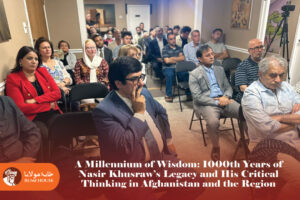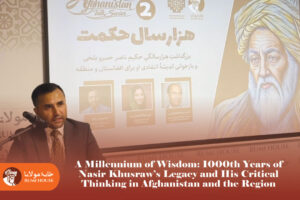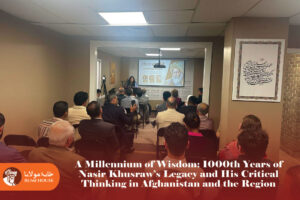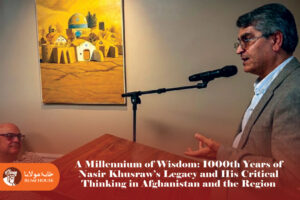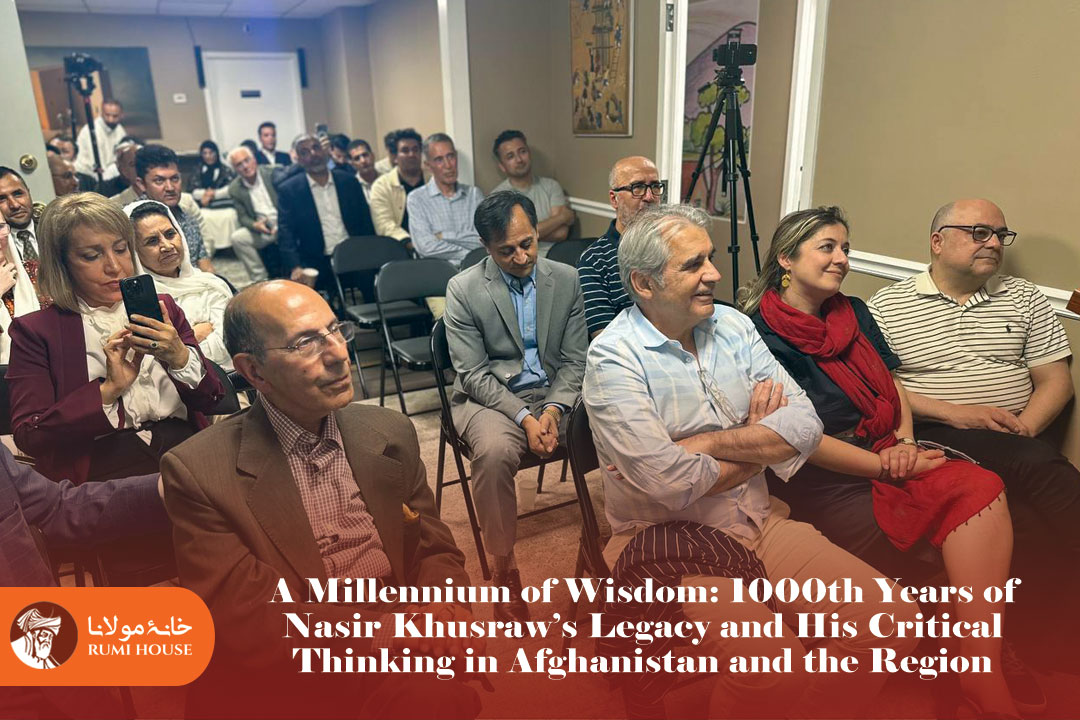
The second session of the “Afghanistan Dialogues” series, titled “A Thousand Years of Wisdom: Commemorating the Millennium of Hakim Nasir Khusraw Balkhi and Re‑examining His Critical Thought in Afghanistan and the Region,” was held on Saturday, May 30, 2026 at the Rumi House in Virginia, United States.
The gathering brought together scholars, professors and members of Afghanistan diaspora community in Washington D.C, Virginia and Maryland.
Opening the event, Wesna Saidy welcomed participants and outlined the goals and themes of the cultural program. She offered a brief overview of Nasir Khusraw’s life and works, describing him as one of the most distinguished thinkers, philosophers, poets, and intellectuals of the Persian Dari language. She emphasized that his ideas remain intellectually stimulating and inspirational more than a millennium later.
Speakers highlighted Nasir Khusraw’s enduring place in the intellectual and cultural history of Persian-speaking societies in Afghanistan, Iran, Tajikistan, Uzbekistan and other places, portraying him as a foundational figure in the development of critical thought in the Islamic world—an approach grounded in reason, truth-seeking, knowledge, and social responsibility.
Dr. Sayed Makhdoom Raheen, author, researcher, and Afghanistan’s former Minister of Information and Culture, explored various dimensions of Nasir Khusraw’s life and personality. Reviewing the stages of the philosopher’s intellectual journey, he underscored Khusraw’s role in bridging knowledge, philosophy, religion, and literature. Dr. Raheen noted that Khusraw’s writings form a vital part of the region’s cultural heritage and continue to offer insight into contemporary social and intellectual challenges. He stressed the importance of renewed study of Khusraw’s rational and critical perspectives.
Dr. Sayeh Eghtesadi‑Nia, writer, researcher, and university professor, focused on Nasir Khusraw’s Safarnama (Book of Travels), calling it one of the most valuable works of Persian Dari prose. Beyond its literary merit, she said, the text serves as a key source for understanding the social, cultural, economic, and political conditions of various regions in the 11th century. She emphasized Khusraw’s sharp observational style, which has made Safarnama a lasting historical and cultural document.
She also interpreted Safarnama as an inner journey—a psychological and spiritual search for truth rather than a mere pilgrimage. Khusraw’s evaluative and often critical approach to cities, scholars, and societies, she argued, is central to understanding his intellectual method.
In another part of the program, Arbab Rahimi, poet and writer, recited one of Nasir Khusraw’s celebrated qasidas.
Khushnood Nabizada, writer, journalist, and peace activist, discussed Nasir Khusraw’s concept of the “Perfect Human.” He explained that, in Khusraw’s view, the ideal human being is one who harmonizes knowledge, ethics, and action, pursuing truth while serving society. Nabizadah noted that this vision remains relevant today, offering guidance for strengthening dialogue, coexistence, and social responsibility.
Participants emphasized the importance of such events in reviving and promoting the intellectual and cultural heritage of major figures of the Persianate world. They noted that Nasir Khusraw’s ideas continue to hold significant potential for informing cultural, educational, and social discussions in Afghanistan and the broader region.
The program concluded with open cultural dialogue, exchanges among attendees, and a collective tribute to the enduring legacy of Hakim Nasir Khusraw Balkhi in the history of Persian thought and literature.